
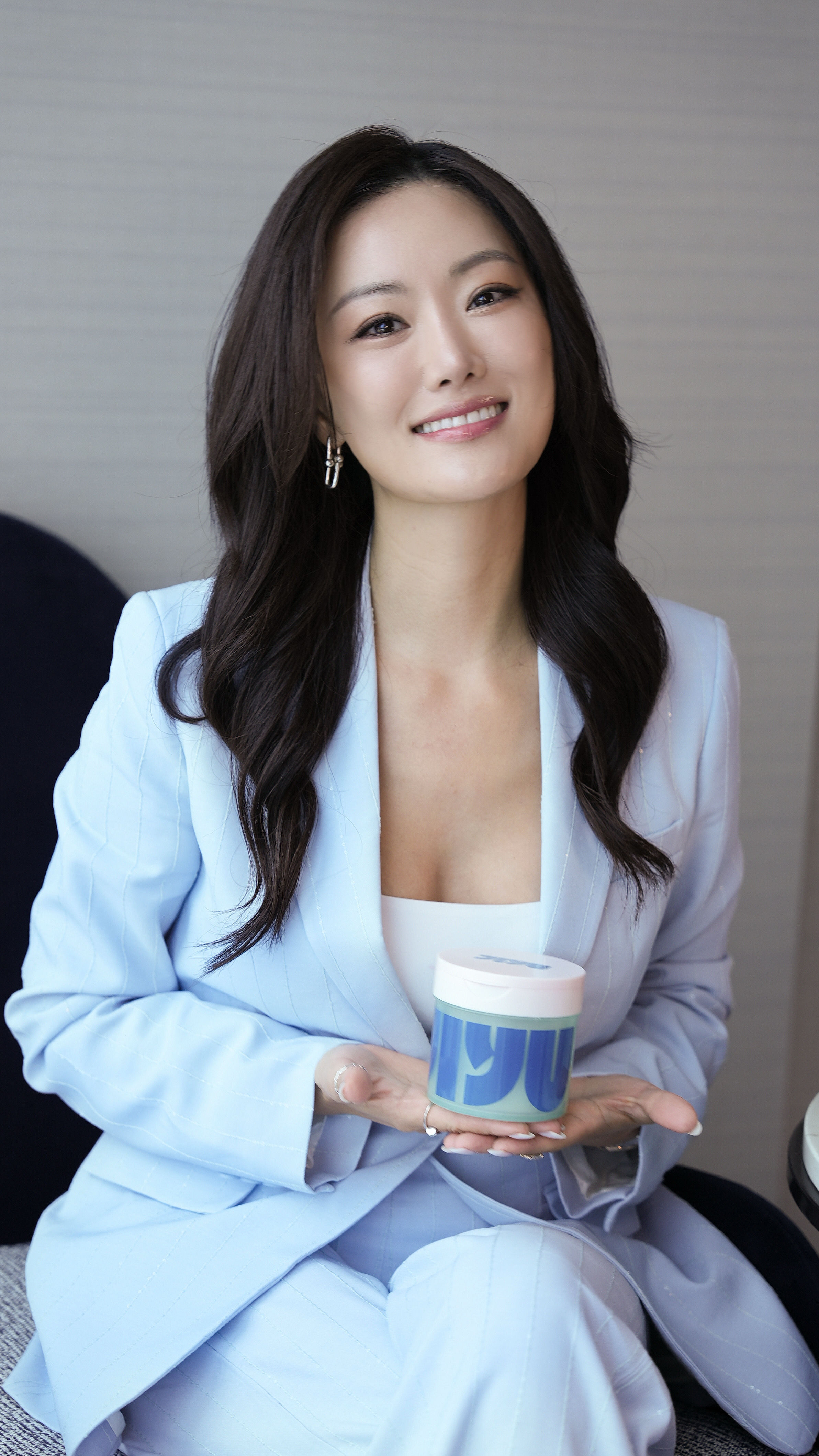
Sora Lee knows what it means to build trust from both sides of the screen.
Before becoming CEO of K-beauty company JIYU, the Korean-born entrepreneur built her career at Netflix, Meta and TikTok, became a founder and creator, and stepped into the public eye on Netflix’s Love After Divorce. Each experience shaped how she thinks about culture, community and the difference between attracting attention and earning genuine trust.
Now, Lee is bringing those lessons to JIYU. She sees an opportunity to pair Korea’s skincare science and speed of innovation with a deeper understanding of American consumers across skin tones, skin types, ages, climates and concerns without diluting the culture behind the products.
K-Snax spoke with Lee about why she chose to lead JIYU, what K-beauty brands need to succeed in the U.S., how creators build credibility and how moving between Korea and America influences her leadership. She also revealed the comfort food she reaches for when the pressure hits.
Let’s jump in:
K-Snax: You’ve gone from Netflix, Meta, and TikTok to founder, creator, and now CEO of JIYU. What did each chapter teach you that you’re bringing into this role?
Lee: Netflix taught me that culturally specific stories can resonate globally without losing what makes them distinctive. Meta taught me about scale and the power of communities. TikTok taught me that brands no longer control the conversation—they have to earn participation in it. Becoming a founder taught me accountability, and being a creator taught me how quickly people recognize what is authentic. At JIYU, I get to bring all of those lessons together.
K-Snax: What made JIYU the company you wanted to join as CEO, rather than just advise?
Lee: JIYU already had what many brands spend years trying to find: strong products, real consumer demand, and significant momentum. But I also saw the opportunity to build something much bigger — a company that applies Korean science and innovation to the diverse skincare needs of American consumers. I didn’t want to advise that vision from the sidelines. I wanted to help build it.
K-Snax: A lot of people first discovered you through Netflix’s Love After Divorce, but your professional background is in building brands and understanding platforms. How did being visible on-screen change the way you think about personal brand, trust, and community?
Lee: Being on-screen taught me that a personal brand is not something you can completely engineer. People build trust through the totality of what they see: your choices, your consistency, and your willingness to be imperfect.
It made me more thoughtful about the difference between visibility and trust. Visibility may introduce you, but trust is earned over time. That is equally true for people and brands.
K-Snax: JIYU is growing at a time when K-Beauty is no longer niche in the U.S. What do you think American consumers finally understand about Korean skincare, and what do they still get wrong?
Lee: American consumers now understand that K-Beauty is not simply about novelty or a ten-step routine. It represents serious formulation expertise, science, speed of innovation, and an emphasis on caring for the health of the skin over time.
What is still misunderstood is that K-Beauty is not a monolith. A product being made in Korea does not automatically make it relevant to every American consumer. JIYU’s opportunity is to combine Korean innovation with a deeper understanding of America’s diversity—across skin tones, skin types, ages, climates, and concerns.
K-Snax: You’ve helped Korean beauty brands enter the U.S. through Kurated Agency. What separates the Korean brands that translate well globally from the ones that struggle outside Korea?
Lee: The brands that succeed have a clear reason for existing beyond simply being Korean. They understand their consumer, can explain the value of their innovation, and have the operational discipline to support growth.
The brands that struggle often assume that success in Korea will translate automatically—or they localize so aggressively that they erase what made the brand special. The goal is to translate the benefit without diluting the identity.
K-Snax: What’s one lesson from your time at TikTok that still shapes how you think about brand-building, creators, or community today?
Lee: Brands do not create culture by themselves; they participate in culture with communities.
Creators are not simply a distribution channel. They are educators, storytellers, and trusted interpreters of products. The strongest brands give creators room to be credible rather than trying to control every word. You can buy visibility, but you cannot manufacture trust.
K-Snax: As a Korean-born entrepreneur building across the U.S., Korea, and global markets, how much of your leadership style is shaped by moving between cultures?
Lee: Almost all of it. Moving between cultures taught me to listen for what is meant, not only what is said, and to recognize that the same idea may need to be communicated differently in different environments.
My leadership style combines the rigor, speed, and attention to craft that I experienced in Korea with the experimentation, directness, and individual ownership I learned in the U.S. I see my role as building a bridge between those strengths—not forcing one side to become the other.
K-Snax: For Asian American and Korean American consumers, K-Beauty can feel both mainstream and deeply personal. How do you think about building a brand that speaks to a broad audience while still honoring the culture it comes from?
Lee: You honor the culture through substance, not simply aesthetics. That means respecting where the science, formulations, manufacturing, and rituals come from—and representing that origin truthfully.
At the same time, broad relevance does not require cultural dilution. JIYU can remain grounded in Korean innovation while serving the diversity of American skin. In many ways, specificity is what makes a brand globally meaningful.
K-Snax: Since we’re K-Snax, we have to ask: what are your favorite Asian snacks?
Lee: This may be the hardest question because I eat pretty healthy and rarely snack! But when I’m really stressed, my comfort food is Carbonara Buldak. I know it’s technically not a snack, but that’s my honest answer. And every now and then, I love a Tokyo Banana.
Follow Sora Lee:
Follow JIYU:


Leave a Reply