
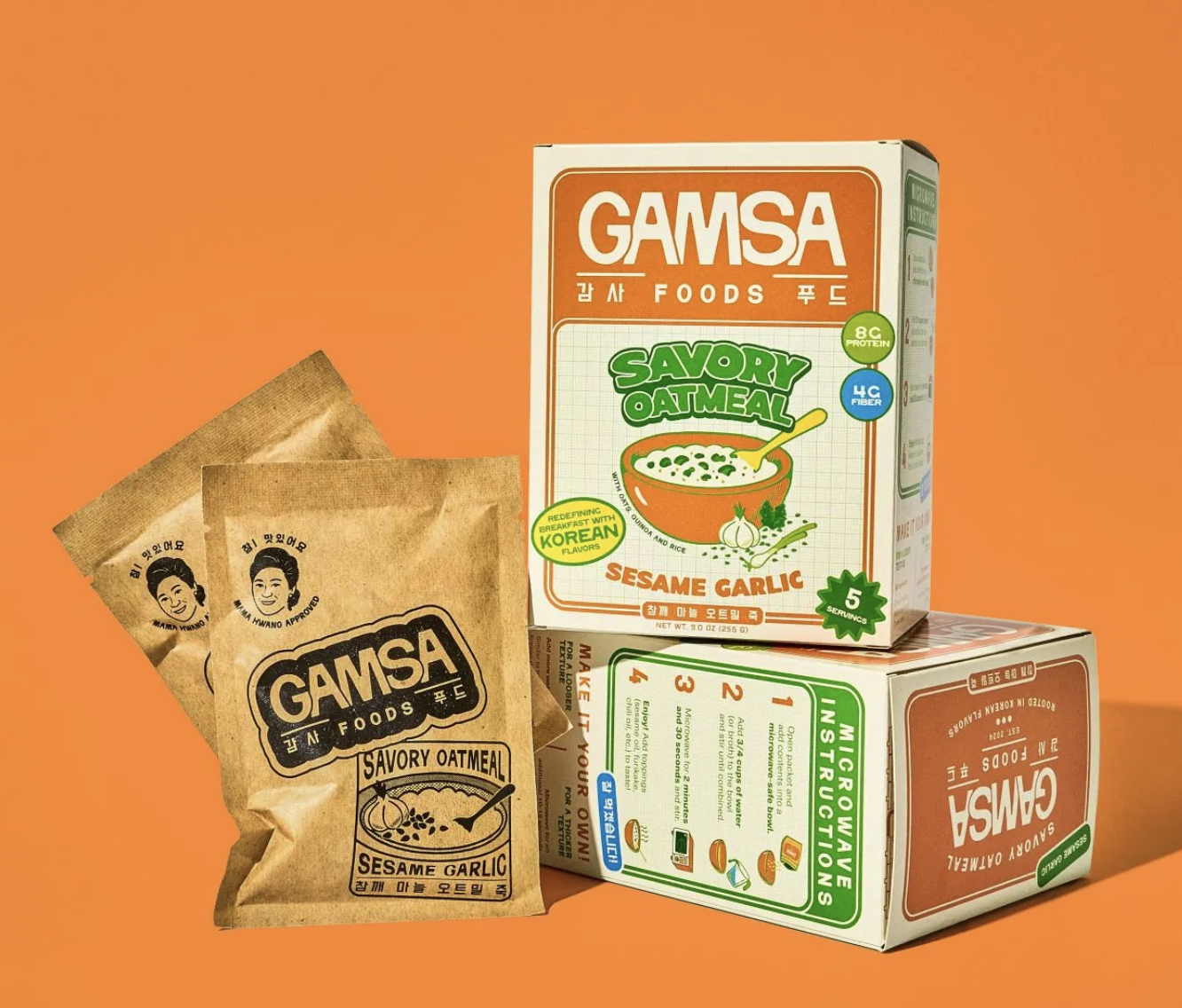
Sarah Hwang didn’t grow up eating cereal for breakfast.
In her house, mornings were rice, kimchi, banchan, eggs, soup, or juk. Cereal and Pop-Tarts were the foods she saw on TV and begged her mom for, but they were more of a snack or dessert than breakfast.
Years later, Sarah was traveling almost every week for work and noticed how hard it was to find a quick savory breakfast. Everything convenient was sweet: oatmeal, pastries, bars, yogurt. Anything warm and savory usually meant sitting down at a hotel buffet before an early meeting.
That’s when she started thinking about the juk she grew up with. Her mom had been mixing oats, quinoa, and brown rice into their family meals for years. Sarah never thought of it as oatmeal. It just tasted like home.
Gamsa Foods came from that memory, and it posed a bigger question: why does American breakfast have to be so sweet?
We talked with Sarah about the differences between Korean and American breakfast, building her brand from an in-between identity, and how Gamsa is rooted in gratitude.
Let’s jump in and learn more about Gamsa Foods:
K-Snax: Gamsa is inspired by Korean juk, but built around oatmeal, which is such a familiar American breakfast food. When did those two ideas first click together?
Sarah: Growing up Korean American, my parents always found ways to adapt Korean cooking to fit our life in the U.S. My dad has diabetes, so plain white rice was actually a treat in our house because of its high glycemic index. Instead, my mom would mix oats, quinoa, and brown rice into our rice. On weekends, she’d use the leftover grain mix to make juk with vegetables, garlic, soy sauce, and sesame oil. Honestly, I never even realized there were oats in it. To me, it just tasted like my mom’s juk/rice porridge.
Years later, I was traveling almost every week for work and living out of hotels. I realized every convenient breakfast option leaned sweet. If I wanted something savory, I had to sit down at the hotel buffet, which wasn’t realistic before early meetings. I tried making savory oatmeal with eggs and soy sauce but I couldn’t get past the slimy texture. That’s when I started thinking about the juk grew up eating. My mom’s juk had oats in it too, yet it tasted completely different. The more I thought about it, the more I realized almost every culture has a savory grain porridge. Korea has juk, China has congee, the Philippines has arroz caldo, India has pongal, and even traditional Irish oatmeal is often eaten with a pinch of salt. So why had oatmeal in the U.S. become almost exclusively sweet? That’s when the idea clicked. It wasn’t about recreating my mom’s recipe. It was about showing people a different way to think about oatmeal and expanding what breakfast could look like.
K-Snax: Your site says you grew up between two breakfast tables: Korean juk at home and American oatmeal everywhere else. What did breakfast represent to you growing up?
Sarah: Breakfast was actually where I felt the most Korean! Like a lot of Asian Americans, I had the traumatic lunchbox experience growing up. After bringing kimbap to school one day and getting comments about how it smelled, my mom started packing me American lunches so I could fit in. She even learned to make PB&Js, sandwiches, and wraps from parenting magazines. Dinner became a mix too, with Korean food alongside burgers, spaghetti, and lasagna. But breakfast never changed.
Every morning was rice, kimchi, banchan, eggs, soup, or juk. My mom believed a savory breakfast kept you full longer and gave you better energy for the day. Meanwhile, all I saw on TV were cereal and Pop-Tart commercials. My sister and I begged my mom for those breakfasts but she only let us have them as snacks or dessert.
Looking back, breakfast was the one meal where we never assimilated. I never saw the foods I grew up eating represented in mainstream American breakfast culture and I really appreciate that my mom never budged. It became the daily ritual that kept me connected to my Korean identity and ultimately inspired Gamsa.
K-Snax: Gamsa was born from an “in-between space,” not fully Korean or fully American, but both at once. Does building a food brand help you make sense of that identity?
Sarah: Absolutely! If anything, building Gamsa helped me realize that Korean American isn’t a compromise between two identities. It’s its own identity.
Growing up, I ate Pocky and Oreos, tteokbokki and pizza bagels, Shin Ramen and Kraft Mac & Cheese. As an adult, especially after dealing with my own health issues, I started paying much more attention to what I was eating and found myself looking for better-for-you versions of the foods I grew up with. I could easily find better-for-you versions of American household staples, but I struggled to find that same innovation for the Korean foods I loved.
I also realized I was shopping at both H Mart and Whole Foods every week and there are millions of people who do the same. But when Korean flavors show up in mainstream grocery stores, they’re often represented by large conglomerate brands. There are few emerging brands reimagining Korean foods for consumers who care about ingredients, nutrition, and convenience, but don’t want to give up the flavors and traditions they grew up with!
For so long, it felt like you had to choose between eating healthier and staying connected to your culture and I don’t think those should be competing priorities. That’s really how I think about Gamsa. We’re building a better-for-you Korean American food brand that reflects how Korean Americans actually live and eat today. We happened to start with breakfast because it’s one of the most routine meals of the day, yet it’s also one of the least diverse and least innovative categories in the grocery store. If we can help redefine what breakfast looks like, we hope that’s just the beginning of bringing more Korean American foods into everyday grocery aisles.
What was the hardest part of turning something as comforting and slow-cooked as juk into a shelf-stable, ready-in-minutes product?
Sarah: Honestly, the hardest part wasn’t the food science. It was letting go of the expectation that I could recreate my mom’s juk exactly! No shelf-stable product is ever going to replace a bowl of homemade juk that’s been simmering for hours and that’s not what we’re trying to do.
Once I accepted that, our approach completely changed. Instead of asking, “How do we recreate my mom’s recipe ingredient for ingredient?” we started asking, “What makes a bowl of juk feel so comforting?” That led us to focus on building layers of umami and depth in different ways. I’d say about 80% of the ingredients in our product are inspired by what my mom uses, but we also incorporated ingredients like miso and wakame because they help recreate the richness and savory flavor that normally takes hours to develop. he goal was never to replace homemade juk. It was to create something that captures that same feeling of comfort on the mornings when you don’t have time to cook for three hours!
K-Snax: Gamsa means gratitude or appreciation in Korean. How does that idea show up in the product, the brand, and the way you’re building the company?
Sarah: Gratitude is really the reason Gamsa exists! My cofounder Ruby and I are both daughters of immigrant parents and first-generation college graduates. Our parents became entrepreneurs out of necessity, not because it was their dream but because it was how they survived. We watched them work weekends, sacrifice family time, and build businesses without paid time off, benefits, or the safety nets many people take for granted. Their dream wasn’t for us to become entrepreneurs. It was for us to have stability.
We followed that path. We worked hard, earned scholarships, went to good schools, and landed the corporate jobs they had always hoped we’d have. Ironically, Ruby and I always talked about entrepreneurship. We were huge fans of Shark Tank and How I Built This, and we’d talk about one day starting a company together. But it always felt like one of those dreams that other people got to pursue, not us.
It wasn’t until business school that I realized the greatest way I could honor my parents’ sacrifices wasn’t by staying on the safest path forever. It was by using the opportunities they worked so hard to give me to build something meaningful. They sacrificed so I could have the freedom to choose, and building Gamsa is my way of honoring that.
That’s where the name Gamsa came from. It’s a reminder to stay grateful for the sacrifices that came before us, for the people who believed in us, and for the privilege of getting to choose our own path.
That mindset shapes how we build the company too. We think long term, we build genuine relationships instead of transactional ones, and we collaborate whenever we can because we know we didn’t get here on our own. Even our product reflects that idea. Juk has always been a meal that’s made to comfort and care for someone else, and we hope every bowl carries a little bit of that same feeling forward.
K-Snax: You’ve been very open in The Persimmon Diaries about the emotional side of building Gamsa: uncertainty, fundraising, rejection, and going full-time. What have been the biggest challenges for you so far?
Sarah: I think the biggest challenge has been changing how I think about success. Growing up as the eldest daughter of Korean immigrant parents, success was pretty clearly defined. Work hard, don’t make mistakes, get good grades, land the corporate job, and keep climbing. That’s the path I followed for most of my life.
Building Gamsa has forced me to let go of that mindset. Entrepreneurship is messy. You’re making decisions with incomplete information, hearing “no” far more than you hear “yes,” and constantly trying things that may not work.
Early on, every rejection felt like I had done something wrong. Now I see it differently. I try to look at every setback as another data point instead of a verdict. Whether it’s an investor passing, a retailer saying no, or a production issue, we always ask ourselves, “What can we learn from this?” Every mistake helps us make a better decision the next time.
I think that’s been the biggest shift for me. Instead of trying to avoid failure, I’ve learned to see it as part of the process. Building a company isn’t about getting everything right. It’s about learning a little faster each time and trusting that if you keep showing up, the odds slowly start to move in your favor.
K-Snax: For someone trying Gamsa for the first time, what’s your ideal bowl? Do you add egg, kimchi, sesame oil, chili crisp, broth, or something else?
Sarah: I actually keep it really simple because that’s how I eat it most mornings. I always add kimchi and a drizzle of sesame oil since those are two things I pretty much always have in my fridge. If I have a little extra time, I’ll throw an egg on top!
K-Snax: What has surprised you most about how people respond to savory oatmeal?
Sarah: I’ve been surprised by how many people tell us they already eat savory oatmeal at home. Almost every time, it’s with Asian-inspired flavors like soy sauce, chili crisp, eggs, or kimchi. We thought we’d have to convince people to try savory oatmeal, but instead we found many people were already craving a savory, convenient breakfast. The demand was already there. It just wasn’t being reflected on grocery store shelves.
K-Snax: What are your favorite Asian snacks?
Omg this is so hard to choose! My top four are:
- Tteok (Korean rice cakes) and my favorite is mujigae tteok (rainbow rice cake).
- Orion Choco Pie. It has to be Orion not Lotte. Orion is the OG… iykyk.
- Roasted goguma (Korean sweet potato). Especially in the winter.
- Tamago Boro (the ones with characters that come in a long package!).
Follow Gamsa Foods:



Leave a Reply