
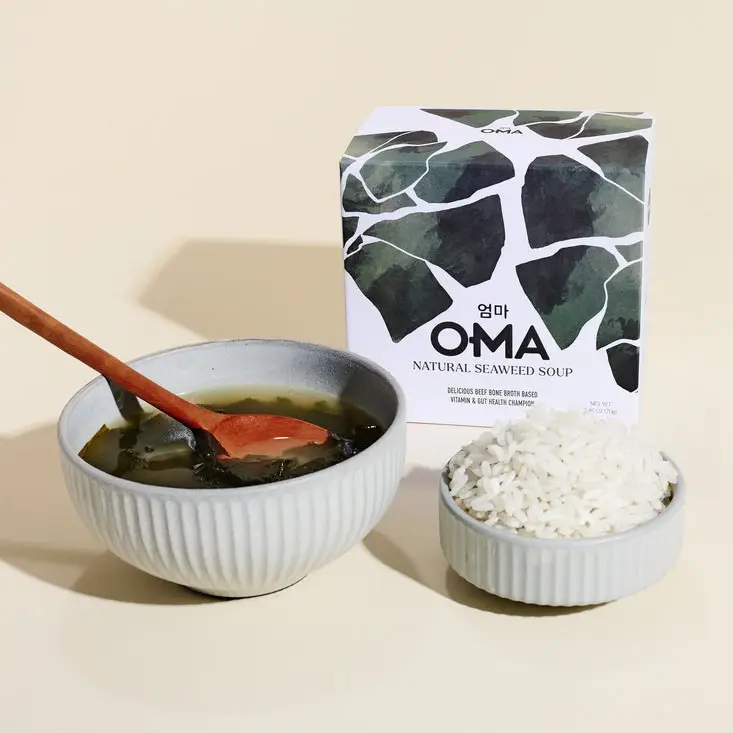
For many Korean families, miyeok-guk is tied to some of the most important moments in life. It’s traditionally eaten after childbirth, then again on birthdays as a way of remembering the mother who gave birth to you.
OMA founder Yondjé Choi grew up eating miyeok-guk with her family, but she came to understand the tradition in a new way after becoming a mother herself. During postpartum recovery, her own mom made miyeok-guk for her every day.
That experience eventually became the foundation for OMA, a modern take on the Korean staple built around the idea of making nourishment easier to reach, whether you’re recovering from childbirth or simply looking for something warm and restorative in the middle of a busy day. We spoke with Choi about the tradition behind miyeok-guk, what American postpartum culture is missing, and what it takes to turn something so homemade and personal into an everyday product.
Let’s jump in to the interview:
For readers who didn’t grow up eating Korean food, what is miyeok-guk, and what are your earliest memories of eating it with your family?
Miyeok-guk literally translates to seaweed broth—it’s a traditional Korean soup made from nutrient-dense brown seaweed (miyeok) and beef. Growing up in a French-Korean household, soup was always our family’s ultimate love language. My mum will always cook this for us for our birthday to follow the tradition, I always love the soup and it was a family meal that everyone would enjoy. She also carries a big thermos wherever we go on a picnic with the soup and serve it to us so we have something warm to eat.
Why do you think miyeok-guk has endured as such a powerful expression of care for new mothers across generations of Korean families?
In Korean culture, food is truly seen as medicine. After giving birth, a woman’s body undergoes immense physical trauma, blood loss, and hormonal shifts. For centuries, Korean women turned to miyeok-guk because seaweed is naturally packed with iodine for thyroid and hormonal recovery, calcium for bone strength, iron to rebuild blood cells, and seaweed fiber for gentle postpartum digestion. But beyond the science, eating miyeok-guk every single day during postpartum is a sacred ritual. It signals to the new mother that she is being mothered, nourished, and cared for while she cares for her newborn. And that’s why it’s eaten for birthday.. In honor of Mother who ate it everyday tor recover!
When you went through postpartum yourself, what did you learn about miyeok-guk (and the tradition around it) that you didn’t know before becoming a mother?
Before having my child, I loved miyeok-guk simply because it was delicious and comforting. But after experiencing a difficult pregnancy and going through my own postpartum recovery, my mother stepped in and made this soup for me every single day. That was my turning point. I experienced firsthand how transformative real, intentional food can be when your body is completely exhausted. I realized that Korean women aren’t just eating this out of habit—the benefits they’ve obsessed over for generations (hormonal balance, glowing skin, gut recovery, sustained energy) are real. It opened my eyes to the fact that postpartum recovery doesn’t have to feel clinical; it can be deeply restorative and delicious.
Seaweed has long been valued in Korean cuisine for its nutritional benefits. What do you think people in the U.S. still overlook about what it offers?
In the West, people often view seaweed merely as a sushi wrapper or a salty snack pack. What’s overlooked is that ocean seaweed is one of the most nutrient-dense superfoods on the planet.
It helps with gut health. Seaweed actually contains more fiber than kale! Its unique soluble fiber acts as a prebiotic to soothe digestion and feed good gut bacteria.
It helps with hormonal & thyroid health. 1 out of 3 women in the U.S. are iodine deficient. Seaweed is nature’s most potent source of bioavailable iodine to help balance thyroid function and metabolism.
Lastly, it helps with skincare. Korean women treat seaweed as “edible skincare” because it’s packed with collagen-supporting minerals, Vitamin K, and antioxidants that support skin, hair, and nails from the inside out.
Koreans also eat miyeok-guk on their birthdays. What does that tradition mean to you, and how do you think about the connection between birthdays, mothers, and the soup?
I love this tradition so much. On your birthday in Korea, you don’t just celebrate yourself, you eat miyeok-guk to honor your mother and the sacrifice she made giving birth to you. It connects your birth day directly back to the soup she ate while healing from bringing you into the world. It’s a beautiful circle of gratitude: honoring the woman who gave you life while nourishing your own body for another year of longevity.
Did you see a gap in how postpartum recovery and nourishment are approached in the U.S.? If so, how did that influence your decision to build OMA?
Absolutely. In Western culture, the moment a baby is born, 99% of the focus shifts entirely to the baby, while the mother is often left to fend for herself with cold meals, heavy vitamin pills, or processed convenience foods. There is very little cultural infrastructure around mothering the mother. When I looked around, I saw women dealing with gut issues, hormone crashes, and total burnout without accessible, restorative food rituals. I created OMA, which means “mother” in Korean, to bridge that gap. I wanted to translate this ancient “food as medicine” ritual into a modern, elevated format not only for new moms but for everyone in the US so they could easily integrate into their daily lives.
Miyeok-guk is such a homemade and emotionally meaningful dish. What was hardest about turning it into a convenient packaged product without losing what makes it special?
The biggest challenge was maintaining the authentic, homemade taste and rich texture without resorting to artificial additives, excess sodium, or low-quality ingredients. When people hear “instant soup cube,” they usually expect a salty, artificial bouillon block. But using freeze-drying technology locks in the fresh nutrients, deep broth flavors, and whole pieces of high-quality seaweed, so that when you add boiling water, it blooms into a rich, golden broth that truly tastes like it simmered on a stove for hours. It had to taste like a mother made it.
Once you actually brought OMA to market, what became the biggest challenge? Was it consumer education, retail, manufacturing, getting people to try an unfamiliar dish, or something you hadn’t anticipated at all?
It was definitely consumer education around the format versus the experience. People would see our lightweight 10g freeze-dried cube and be skeptical: “How can a tiny cube turn into a rich, deeply satisfying soup?” But once they poured hot water over it and saw whole, luscious pieces of seaweed rehydrate in a golden bone broth, their eyes opened. Our biggest hurdle was simply getting that first taste into people’s hands. Once they tried it, they immediately understood why Michelin-star chefs in New York and editors at Bon Appétit fell in love with it, because the flavor speaks for itself.
Ours has the specify that we added bone broth, which isn’t typically the case in the traditional recipe. I wanted to be truly nutrient dense and personally love bone broth for digestive/gut health benefit too.
What would it mean to you to see miyeok-guk become a familiar part of more American households, not just for postpartum recovery, but as an everyday food people genuinely love?
It would mean everything to me. While OMA was born from a postpartum tradition, OMA is truly meant for everyday nourishment. Whether you need a quick nourishing breakfast, a gut-restoring afternoon 35-calorie snack at your desk, a post-workout recovery broth, or a soothing evening ritual before bed. My goal is to make Korean wellness rituals as seamless and ubiquitous in American kitchens as matcha or olive oil. Seeing people open a box of OMA to nourish themselves during their busiest daysfeeling energized, balanced, and cared for—is the ultimate fulfillment of our mission.
Now people are being very creative creating their own OMA recipe, adding egg, noodle, peas, corn, I absolutely LOVE to be surprise by our customers on how creative they are use OMA as a base soup and making their own custom meal Truly makes me so happy!
OMA is very versatile and that’s what we realize over time people love to add and share their creative toppings!
Because we’re K-Snax, we have to ask: What are your favorite Asian snacks?
I love banana milk. don’t know if it counts as a snack; otherwise, I love red bean bread! Those are the 2 first things I buy when I land in Korea!
Follow OMA:


Leave a Reply