
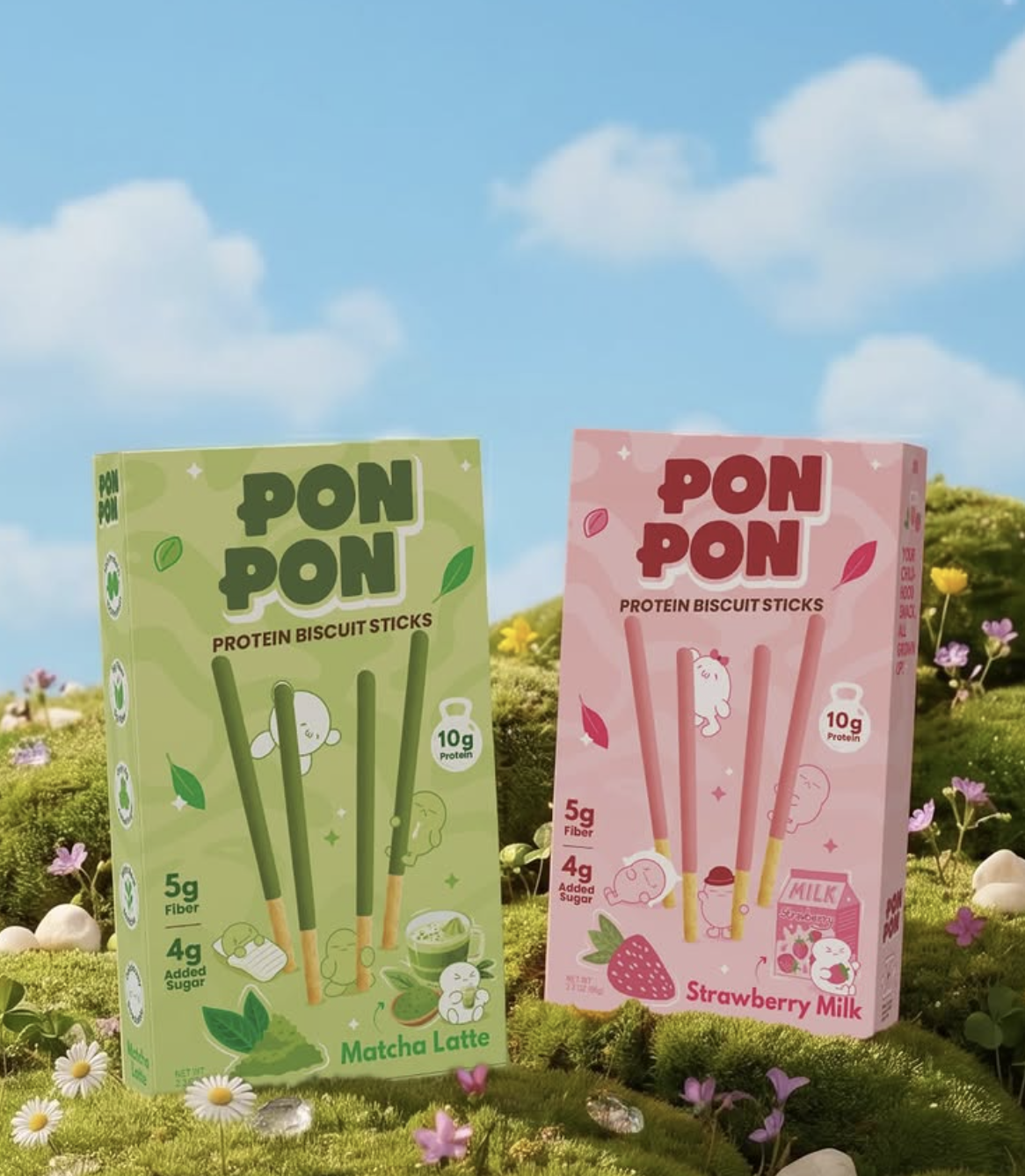
If you grew up eating Pocky or Pepero, you probably remember the simple joy of ripping open a box, pulling out a stick, and finishing the whole thing before you realized it.
Pon Pon Snacks is taking that nostalgic biscuit-stick format and giving it a better-for-you update.
Founded by Lauren Pon, Pon Pon Snacks is made with protein, fiber, and less sugar, while still keeping the light, snackable feeling people love about Asian biscuit sticks.
We talked to Lauren about building a protein biscuit stick that still feels light and delicious, testing more than 200 recipes, and designing packaging that feels softer and more fun than typical protein snacks.
Let’s jump in and learn more about Pon Pon Snacks:
K-Snax: Pon Pon is clearly speaking to people who grew up with Pocky, Pepero, and even Yan Yan. What memories do those biscuit sticks bring up for you?
Lauren: Biscuit sticks bring me right back to Chinese school. When I was in second grade, my mom would pick me up from regular school and almost always surprise me with a snack for the drive. Sometimes jellies, sometimes Pocky, sometimes boba. I never knew what she’d bring, and that little bit of mystery made it special. It was such a simple way for us to bond.
K-Snax: Pocky and Pepero are iconic because they’re not just snacks. They’re tied to sharing, nostalgia, and even moments like Pepero Day in Korea. What parts of that experience did you want Pon Pon to preserve, and what parts did you want to rethink for today?
Lauren: In the age of AI, when everything is so fast-paced, I think people are feeling really nostalgic for simpler times, and that’s woven right into our branding. So much of what we represent is community and the value of actual face-to-face time: making the effort to meet up, go on a picnic, have real conversations instead of just texting. I want Pon Pon to be a reminder that you can chase your modern-day goals and still stop to share a cute snack with your friends. Not everything in your life needs to be hyper-functional and hyper-optimized. Take life seriously, but don’t take yourself too seriously, and remember that life is so much more than busywork.
I also think we need to bring back more of that sharing. At least in the US, we’re so focused on our individual goals, especially in fitness, where it’s all about “you versus you.” But I want Pon Pon to be a moment where people actually share and realize there’s a community effort behind everything. You really do need a strong community supporting you, and you can involve everyone on your health journey.
That’s also where my fitness background comes in. I want people to remember that health isn’t just about working out and hitting your macros; it’s about mental and emotional well-being too, and being able to enjoy the moment with food that actually tastes good instead of eating a piece of cardboard. I think Pon Pon is a great bridge there. We taste great, we’re a better-for-you snack, and we’re perfect for the everyday person who just wants to be a little healthier.
K-Snax: How did your background in fitness help inform the R&D for Pon Pon Snacks?
Lauren: Fitness did help with R&D, but honestly only a little. Where it really helped was understanding macros and knowing what people actually want to see in a protein snack: more protein, less sugar, more fiber, healthier ingredients, overall health-conscious. Having been in the fitness industry for ten years, I knew what I myself and others would want, so it helped me make a snack I’d actually want to eat.
But the R&D itself was a whole other beast. I learned to do really good R&D on my own through basically three years of making stuff in my kitchen, failing, and a ton of trial and error. So fitness sparked the interest and gave me the instinct for making a better-for-you snack, but baking and developing something in your kitchen versus knowing how to lift weights are two totally different skills. The only real overlap was the interest and knowing how to read an ingredient label.
K-Snax: What was the hardest part of adding protein and fiber without losing the light, snackable feeling people expect from this kind of treat?
Lauren: The hardest part was realizing you can’t just throw protein and fiber into a snack and hope it tastes good and has the right texture. I tried so many different proteins and glutens. When I started, I imagined it could be gluten-free, dairy-free, lower-oil. I was trying to strip out everything that’s actually necessary to bake something correctly. So one of the genuinely challenging things was giving up on certain labels like “gluten-free” or “dairy-free.” That said, it doesn’t mean I’ll never do it. I just had to table those ideas for now, and they’re something I may revisit in the future.
Baking a thin stick also comes with a lot of breakage, so there’s constant tweaking in the baking process. Getting that lightness you’re imagining, instead of something that tastes like a hard brick, was really difficult too. There are real limits to what you can do with a snack like this, and that’s why it took three years to master. That lightness comes down to baking science. I baked over 200 trials in my own kitchen before taking it to a co-manufacturer.
And then mass production was another challenge entirely, because this has never been done before. The parameters a factory runs have to change for such a customized project, and honestly not everyone wants to do that. The manufacturing was probably the hardest part. You have to get people to believe in your vision and figure out how to make it doable at scale. That was the longest part by far: making a stick that reminds you of your childhood while still tasting as good, if not better, than you remember.
K-Snax: A lot of protein snacks feel very gym-coded. Pon Pon feels softer, more nostalgic, and more fun. What was the design process like for your brand’s packaging and overall feel?
Lauren: The branding took a really long time to get down. When I first started, I was actually envisioning the same macros you’d see in a protein bar, around 20 grams of protein, a set amount of carbs and fat, and I tried to fit that template into a stick. That was a huge challenge to pull off and still make it taste good.
It also coincided with my own personal fitness journey. I used to compete seriously in powerlifting for years, and right as I started this project, I was going through a transition, trying to discover who I was outside the gym, because so much of my identity had been wrapped up in it. I was starting to decouple myself from thinking about fitness purely in numbers: macros, how much weight I was lifting, how lean I could get, what weight class I could drop into. Everything was numbers-coded and honestly less about health. I was probably at peak physical health, but mentally I wasn’t the healthiest, and my body ached a lot. So I wanted to build something that fit my long-term goals, and I could see other people heading in that same direction.
That’s why I wanted to go in the opposite direction of typical gym snacks and the fitness industry in general. It opens the door for the general population, people who just want to be healthy but don’t necessarily go to the gym, to enjoy the snack too. And the nostalgia piece is key, because I think we’re all getting a little tired of things that feel so polished.
That softer approach even comes through in our messaging. It’s much gentler, more “try again tomorrow if today didn’t work out,” reminding you to slow down. I want to strike that balance between letting people know it’s okay to take breaks and go after the goals they want. I’m really particular about it: it’s supposed to feel like the friend next door encouraging you, not the gym bro telling you everyone has the same 24 hours in a day. I come from a more holistic approach, it’s how I coached my clients too, and I think it’s just a kinder way to do it. I want our snack to feel like that: something that can always be part of your everyday life, that feels happier instead of making you feel like you’re never doing enough.
The branding itself took at least two to two-and-a-half years to figure out, and it started off looking very different from where we landed. A lot of it was influenced by the Japanese snacks I’d see on my solo trip to Japan, those really cute mascots. I wanted our packaging to honor that while bridging it into an east-meets-west vibe: very cutesy, but clearly made for the modern-day American, similar to the snacks we see today.
K-Snax: What made Strawberry Milk and Matcha Latte feel like the right flavors for launch?
Lauren: It just made sense to start with those two. I actually wanted to launch with chocolate as well, but it took much longer to perfect, and I didn’t want to release something that wasn’t up to my standards, so we went with Strawberry Milk and Matcha Latte. They’re really familiar flavors that the American palate loves, and they both speak to the direction we want the brand to go. There’s no deeper meaning behind it. I just knew those would be the most popular. Chocolate will come eventually, but these felt like the right place to start.
K-Snax: You were flooded with preorders for your launch. What was it like to see all those preorders come in after all the hard work you’ve invested in building your brand?
Lauren: I was pretty shocked, honestly. I didn’t have high expectations for preorders. I didn’t think that many people would want to wait that long, since we manufacture overseas and it takes time to ship over. We’d announced the brand back in February 2025 and didn’t open preorders until over a year later, so I figured people might have stopped caring. But they really came through, and it showed me my messaging was right and everything else was falling into place.
It was exciting but also a little nerve-wracking, because you finally have people who believe in you, and now the next step is to actually deliver. It’s very on brand for me to get super excited about something and then immediately be on to the next thing, so I let myself celebrate for a good while, but now I’m focused on getting these into people’s hands. I’ve waited so long for this and we’ve truly perfected it, so I’m just really excited for people to enjoy it. I appreciate that everyone was willing to wait, and I one hundred percent believe it’s going to be worth it.
K-Snax: Since we’re K-Snax, we have to ask: what are your favorite Asian snacks?
Lauren: My favorites are Kasugai gummies, Puccho ramune hard candy, and North Sea fish snacks.
Follow Pon Pon Snacks:

Leave a Reply